Flight operations · EASA ATO
The board plans itself.
ZULUDECK builds tomorrow from what it already knows: who is current, who flew what, which aircraft is closest to maintenance, and which mission each student is due. You review the day instead of assembling it.
The scheduler
Every constraint, every time — without the phone calls.
The hard part of a flying day is not drawing boxes on a grid. It is holding a dozen rules in your head at once and noticing the one that breaks. ZULUDECK holds them for you, and says out loud which one it applied.
- Instructor availability and duty. Who is in, who is off, and how much they have already worked this week.
- What the student is due next. The next mission of their syllabus, with its prerequisites and its rules.
- The right aircraft. Class and type, where it is based, and how many hours it has left before maintenance.
- Licences and medicals, on the day of the flight. Not today's validity — the validity on the date it is planned for.
- Daylight and your base. Sunrise, sunset and the hours your field actually operates.
- Your own rules. Slot design, preferred instructors, which missions may share an aircraft, and everything else you set up once.
What used to be an afternoon of phone calls and a whiteboard becomes a review over coffee. Nothing is scheduled behind your back: you approve the day, move what you want, and the rules follow the block wherever you drop it.
Availability & crew planning
Who is in, who is off, and who is close to their limit.
Instructors and students say when they can fly. Shifts write the month on their own, and the scheduler reads it before it proposes anything — so the day it builds is a day the people in it can actually work.
- Shifts are a rule, not copied cells. A 6-on / 2-off pattern generates October and November by itself; what somebody writes by hand always wins over the pattern.
- Duty and rest limits, watched as the day is built. Hours in a moving window, activity and rest per working day, per instructor and per student.
- What a day off means is yours to decide. Flying a rental on holiday may be fine; doing a duty day is not. The table of day type × flight purpose is a setting.
- Nobody edits the past, and each person only edits their own — checked on the server, not just hidden in the screen.
- Preferred instructors. A student's regular instructors come first in the list; if none of them is free, the flight still happens with someone else. A student who does not fly is worse than a student who flies with the second name.
from uploaded documents reading
- Name
- Laia Maria Puig Ventura
- Date of birth
- 1992-03-14
- Document
- ZD1284537 · checks ✓
- Licence
- ZUL.FCL.014429 · CPL(A)
- Ratings
- SEP · MEP · IR(A)/ME · EN 5
Records that check themselves
Upload the document. The record fills itself — and it gets checked.
A passport, an ID card, a medical, a licence: a photo or a scan is enough. What comes out is a draft record for a person to confirm, with the parts a machine can verify already verified.
- The machine-readable zone is read and verified. Its check digits are arithmetic, not a guess: if a digit doesn't add up, the field is flagged instead of being trusted.
- Names are cross-checked between documents. When the licence and the passport disagree — or one is shorter — it asks. It never decides that two names are the same person on its own.
- The document stays attached to the record. Not just the numbers typed in: the file itself, where you can find it.
- Expiry dates become warnings before they become problems. Medicals, ratings, language proficiency, licences — each with its own notice period.
- Anyone not legal to fly cannot be dispatched. The check runs when the flight is planned and again when it is released.
The cards above are fictitious specimens from a country that does not exist — but the machine-readable lines on them are real format, and their check digits do add up.
Everything a pilot has to keep current, in one wall
Not a folder of scans: a state. Each line knows what it is, when it runs out and who has to be told — and the same state is what the scheduler reads before it puts anybody in an aircraft.
Notice periods are yours (three months and one month, out of the box — renewing a medical or booking an examiner takes weeks). The file itself stays attached: every upload is a new row, because the history is what you show in an audit.
Fleet & maintenance
The aircraft tells you when it stops flying — before it does.
Hours are not typed in anywhere: they are added up from the flights that were closed. What the programme owes — 50 h, 100 h, annual, ARC — is worked out from the last one actually done, and the margin is on the screen before anybody plans a flight.
- Nothing about the due date is stored: it is calculated. A counter drifts the first time somebody reopens a flight, and then there are two numbers and nobody knows which one is right.
- The next interval counts from the check that was actually done (ML.A.302(d)): a 50 h done at 47:30 has the next one at 97:30. Using tolerance moves the hours, it does not give them away.
- A booking is blocked by the length of the flight, not by a fixed threshold. With 60 minutes left and a 90-minute flight, the aircraft would go past the limit in the air.
- Grounding is not a booking. Downtime is its own thing, opens by itself when something falls due, and never closes by itself.
- Each aircraft counts by its own criterion — airborne time, block or tach — because a counter that disagrees with the engineer's is worse than no counter at all.
Syllabus
Your syllabus, not a template of someone else's.
Courses are built the way your school teaches them: your phases, your exercises, your order. Each mission carries its own rules, and the scheduler reads them when it plans.
- Build it once, version it. Drafts stay editable; a published version is frozen, so a student's record always says which syllabus they flew.
- Rules live on the mission. Aircraft class, dual or solo, minimum hours, what must be completed first.
- Assessment by competency. Grades per exercise, with the instructor's notes, feeding the student's progress.
- Progress you can see at a glance. Per student, per promotion, and where each one is stuck.
Tracking · optional module
See the flight, not just the logbook line.
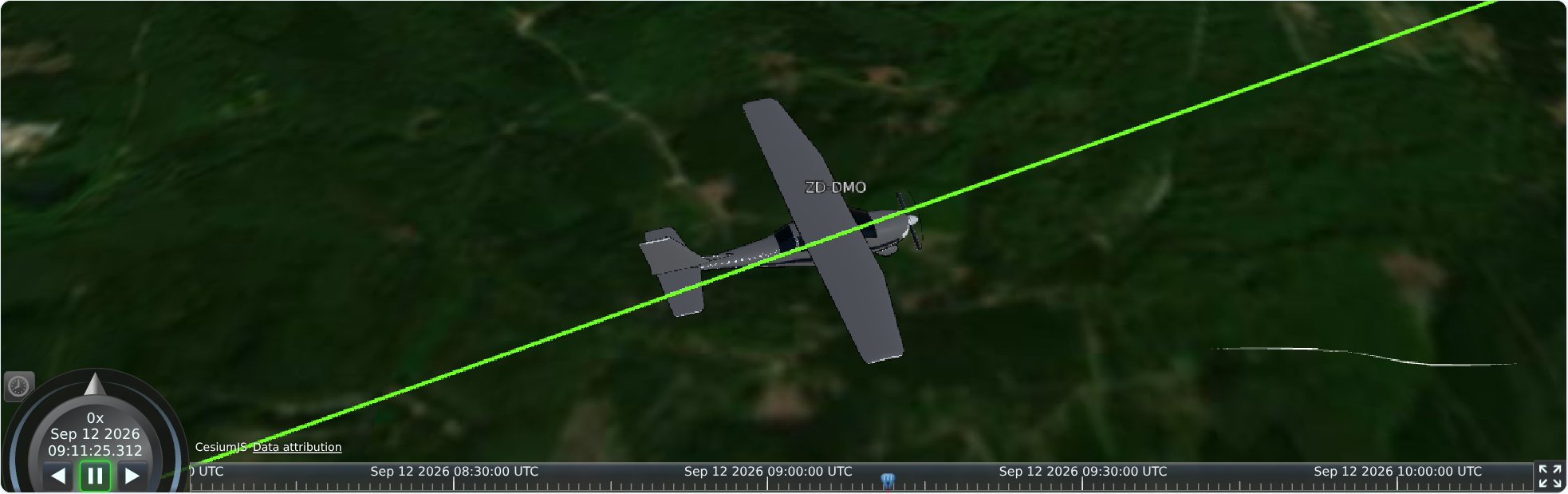
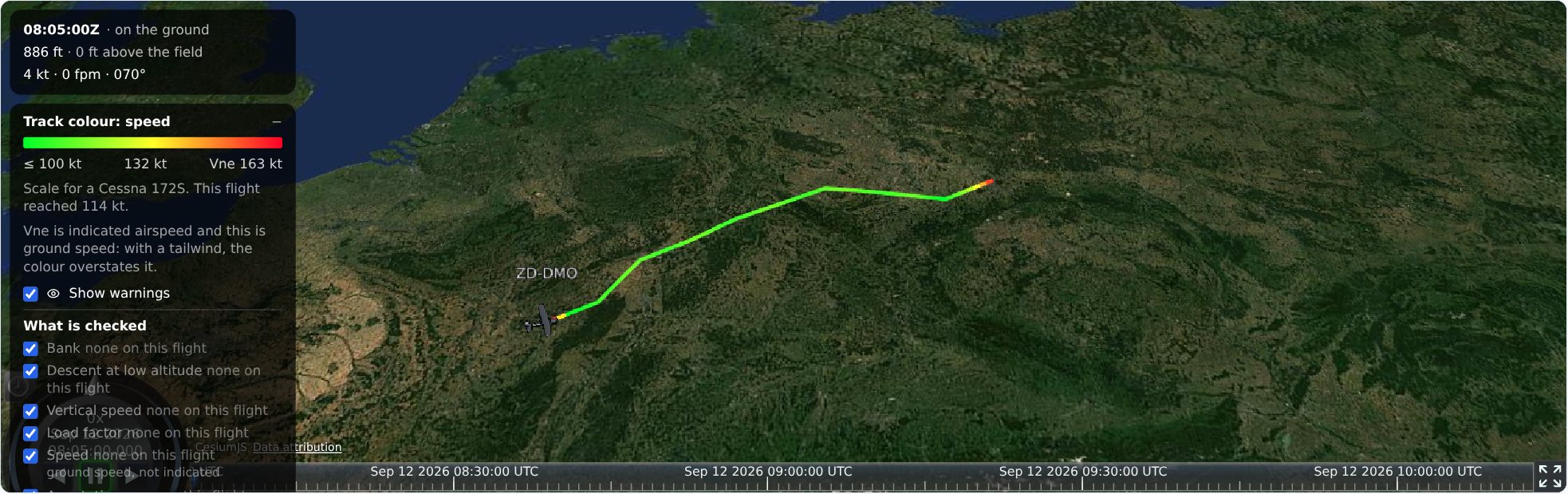
A tracker in the aircraft streams position while it flies. Flights are detected on their own, matched to the booking they belong to, and the times, landings and airfields fill in without anyone typing them.
- The colour means something. Green is cruise, and it warms towards red both when the aircraft is slow and when it approaches the type's VNE — the same scale on every flight, so the same colour always means the same thing.
- 3D replay. The track over real terrain with the aircraft model, a timeline, and the altitude and speed under the cursor.
- Flags, with your thresholds. Bank angle, rate of descent close to the ground, load factor. You set the numbers; the system shows which rule it applied and whether the value was measured or deduced.
- Flown without a booking? The flight is still recorded, and one click turns it into a booking so the hours count towards maintenance.
Integrations
Your hours, where your invoices are made.
ZULUDECK does not try to be your accounting software. It makes sure the thing your accounting software needs — what flew, who flew it and for how long — comes out clean, in the format you already work with.
- A spreadsheet, in one click. Closed flights for the period, with block hours in decimal (1:30 → 1.50), the aircraft, the student, the instructor, the mission, landings and airfields. XLSX or CSV.
- Every row carries its identifiers. Flight id and booking id, so importing the same month twice never charges anybody twice.
- Or skip the file: there is an API. The whole product runs on a documented REST API (OpenAPI) — the same one the app itself uses. Whatever your billing, CRM or BI tool can call, it can read.
- Block and airborne time are kept apart. One is what you invoice; the other is what maintenance counts. A single number would quietly be wrong for one of the two.
- Your data comes out whole. Records export in formats an auditor accepts. What went in stays yours.
Safety reports
An occurrence reported is only useful if somebody can follow it.
Reporting is in the product today: anybody in the school can file an occurrence, with the date, the category, the severity and — when it matters — confidentially. Reports live next to the flights, the aircraft and the people they are about, which is the part a shared folder can never do.
- Today: file, classify, set severity, assign a status and keep the report confidential when the reporter asks for it.
- Next, and we are building it: the full loop — risk matrix, corrective actions with an owner and a date, links to the flight that produced the report, and the trend the authority asks you about.
We would rather tell you what is finished and what is not. If safety management is what decides your choice, ask us in the demo and we will show you exactly where it stands.
Severity × likelihood, with your own tolerance line — and every report landing in a cell you can point at.
Fit
No two schools run the same way. The software shouldn't pretend otherwise.
Most of what makes a school different is not exotic — it is a hundred small decisions. ZULUDECK is built so those decisions are yours, and so changing one of them is a setting, not a support ticket.
Your thresholds, your limits
Duty limits, flight-event thresholds, notice periods, slot design, cancellation reasons — all editable, all per school.
Roles and permissions
Who sees the board, who dispatches, who signs off training, who can reopen a closed flight. Every sensitive action leaves an audit trail.
The day sheet, printed
A printable sheet for the whole school with weather, instructor initials and missions — because the crew room still runs on paper.
Catalan, Spanish, English
Each person picks their own. Aviation terms stay in aviation language: SEP(land) is SEP(land) in every one of them.
Ops, records and tech log
Bookings, logbooks, licences, maintenance margins, defects and the technical log — one database, no spreadsheets bridging them.
Your data, exportable
Records come out as files you can keep. What went in stays yours, in formats an auditor accepts.
Pricing
Priced per school, once we know your size.
A published price table is on the way. In the meantime, tell us your fleet, how many instructors and how many students you run, and we will send you the numbers for your school — with what setting it up involves, and what it does not.
No obligation, and no account needed to talk.
Talk to us
See it against your own week.
The useful demo is not a slide deck: it is your fleet, your instructors and a real week of your school, planned in front of you. Tell us a bit and we will set that up.
Already using ZULUDECK? Log in at alpha.zuludeck.com.